
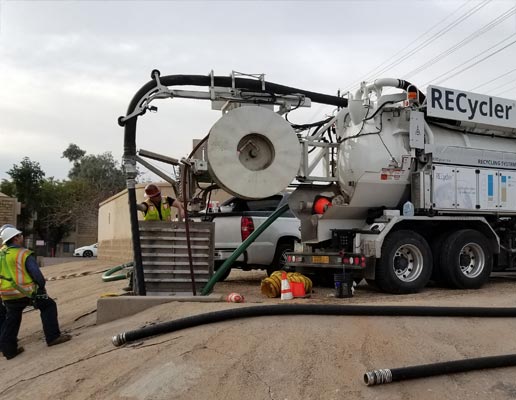
Permanent Fixes That Don't Require Digging
Emergency costs 5-10x more than planned rehabilitation, and traditional replacement requires full excavation, weeks of road closures, and significant restoration costs. The third (and best) option if pipeline conditions allow? Trenchless rehabilitation. Our services restore structural renewal and add decades of additional service life at a fraction of excavation costs.
Methods Matched For Every Condition
Rehabilitation isn't one-size-fits-all. Shenandoah deploys the right technology based on pipe diameter, structural condition, leak severity, and operational constraints.
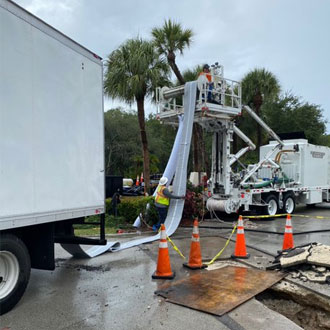
CIPP - Cured-In-Place Pipe Lining
Insert resin-saturated felt liners into existing pipes and cure them in place to create seamless, corrosion-proof systems. With CIPP, you can complete projects in 24-48 hours, stop root intrusion, and extend service life by 50+ years.

Chemical Grouting & Pipe Sealing
Inject polyurethane to seal joints, cracks, and lateral connections without excavation. Grout expands and creates watertight seals in 20-25 minutes, eliminating infiltration, stabilizing soil before sinkholes form, and extending pipe life.
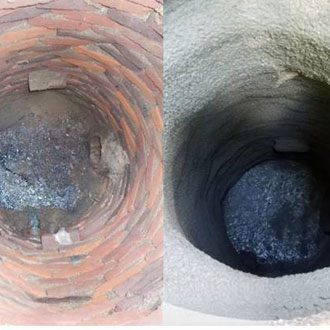
Manhole Rehabilitation
Deteriorating manholes compromise access and create safety hazards. Polyurethane injection seals cracks and joints, stopping groundwater intrusion, often the largest I&I contributor. Preserve crew access, protect adjacent pipes, and prevent sinkholes.
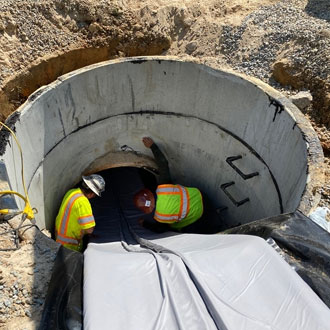
Spray Applied Pipe Lining (SAPL)
When pipes exceed 48″ diameter, CIPP can’t handle them — but SAPL scales to 144″. Spray cementitious mortar using centrifugal force to build load-bearing liners in non-circular and deformed pipes. Deliver 50+ year renewal.
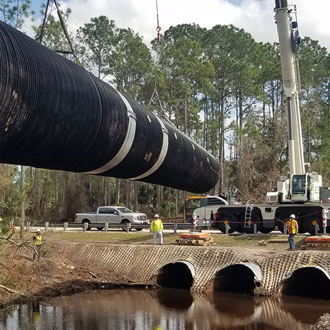
Slip Lining & Pipe Restoration
We insert new HDPE pipe inside existing infrastructure to create a corrosion-proof system that seriously extends lifespan. Slip lining restores pipes that are leaking but structurally sound, stopping infiltration at a fraction of replacement cost.
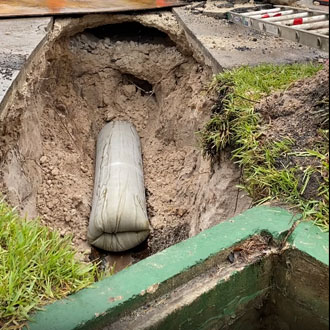
Sectional Lining
Repair localized defects with four-foot liner sections that cure in place in hours. CCTV cameras guide precise installation, delivering structural reinforcement and watertight seals without full-pipe rehabilitation costs or capacity loss. Fastest point repair solution.
Trenchless Repairs Require Total Certainty
Rehabilitation decisions are only as effective as the data behind them. Shenandoah's integrated model uses CCTV inspection and condition assessment to determine which pipes need sealing, which need lining, which need full structural renewal, and which can wait. Why? So your capital dollars target problems in priority order rather than reacting to the loudest failure.
Helpful Resources
Frequently Asked Questions
Trenchless pipe rehabilitation restores the structural integrity of underground pipelines without full excavation. Instead of digging up roads or facilities, methods like CIPP lining, chemical grouting, slip lining, and spray-applied liners renew pipes internally. This approach reduces cost, minimizes disruption, and can extend pipe service life by 50+ years.
Traditional pipe replacement requires full excavation, traffic disruption, surface restoration, and extended downtime. Trenchless rehabilitation:
- Costs significantly less than full replacement
- Avoids major road closures and landscape damage
- Reduces project timelines from weeks to days
- Extends pipe life for decades
When pipe conditions allow, trenchless repair is often the most cost-effective long-term solution.
CIPP lining inserts a resin-saturated liner into an existing pipe and cures it in place to create a seamless, jointless, corrosion-resistant pipe within the original structure.
Benefits of CIPP include:
- Stops root intrusion and leaks
- Restores structural strength
- Minimal service disruption
- 50+ year design life
- Completion in as little as 24–48 hours
CIPP is ideal for sanitary sewer and stormwater pipe rehabilitation where structural renewal is required.
Chemical grouting injects expanding polyurethane into cracks, joints, and lateral connections to create a watertight seal. It is commonly used to stop infiltration and inflow (I&I) in stormwater and sanitary systems.
Grouting:
- Seals leaks in 20–25 minutes
- Stabilizes surrounding soil
- Prevents sinkhole formation
- Extends pipe and manhole life
It is best suited for structurally sound pipes experiencing joint leakage or groundwater intrusion.
Manholes are often the largest source of infiltration in aging sewer systems. Manhole rehabilitation uses polyurethane injection and structural coatings to:
- Seal cracks and joints
- Stop groundwater intrusion
- Protect adjacent pipes
- Preserve safe crew access
Rehabilitating deteriorating manholes reduces I&I, lowers treatment costs, and prevents surface failures.
Spray Applied Pipe Lining (SAPL), also known as spin casting, uses centrifugal force to apply cementitious mortar or structural lining materials inside large-diameter pipes.
SAPL is ideal for:
- Pipes larger than 48 inches (up to 144 inches)
- Non-circular or deformed pipes
- Large stormwater conveyance systems
This method restores load-bearing capacity and provides 50+ years of renewed service life.
Slip lining inserts a new HDPE pipe inside an existing pipeline to create a corrosion-resistant system. It is best used when the original pipe is structurally stable but leaking.
Slip lining:
- Stops infiltration
- Extends lifespan significantly
- Costs less than excavation
- Minimizes surface disruption
It is a proven solution for long-run pipe restoration projects.
Sectional lining targets localized defects using short liner segments, typically four feet long, that cure in place within hours. Guided by CCTV inspection, this method reinforces specific problem areas without lining the entire pipe.
It is ideal for:
- Isolated cracks
- Offset joints
- Localized root intrusion
- Point repairs requiring rapid turnaround
Sectional lining is one of the fastest trenchless repair solutions available.
Most structural trenchless rehabilitation methods, including CIPP and SAPL, provide a design life of 50+ years when properly installed. Chemical grouting and point repairs extend system life and prevent early failure, reducing lifecycle costs.
Rehabilitation decisions depend on pipe diameter, material, structural condition, infiltration severity, and operational constraints. Shenandoah uses CCTV inspection and condition assessment to determine whether a pipe requires sealing, lining, structural renewal, or scheduled monitoring.
Data-driven rehabilitation ensures capital budgets target the highest-risk assets first.
Yes. Trenchless rehabilitation methods such as CIPP lining, chemical grouting, manhole sealing, and slip lining eliminate groundwater infiltration and inflow. Reducing I&I lowers treatment costs, prevents system overload during storms, and protects downstream infrastructure.
Many trenchless projects can be completed in days rather than weeks.
- CIPP: 24–48 hours in many cases
- Chemical grouting: under 30 minutes per defect
- Sectional lining: hours per repair
Project timelines vary by scope, but trenchless solutions dramatically reduce downtime compared to excavation.