

When Small Cracks Become Big Problems
Manholes provide critical access to sanitary and stormwater systems, but they're often neglected until failure forces action.
Infiltration through cracked walls and degraded joints allows groundwater and roots to enter, slowly resulting in structural failure, sinkholes, or complete collapse. Trenchless rehabilitation restores integrity at a fraction of the cost without tearing up streets or disrupting operations.
Seal, Stabilize, and Protect Without Disruption
Before: Excavation and Reconstruction
Conventional manhole repair means excavating around the structure, removing deteriorated sections, rebuilding walls, and restoring surfaces. For systems with multiple failing manholes, costs spiral as crews work through structures one at a time — closing roads, rerouting traffic, and stretching timelines for weeks.
After: Like New-Condition Without Downtime
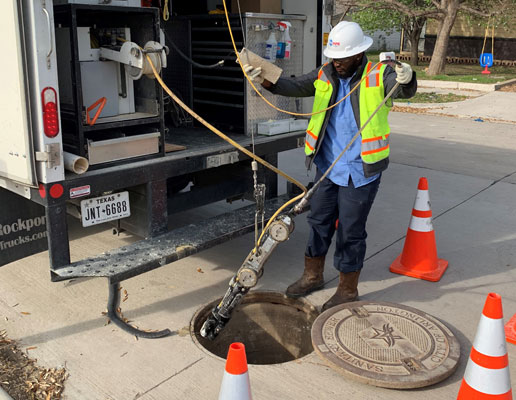
Shenandoah’s manhole rehabilitation uses polyurethane injection and protective coatings to restore structural integrity from inside. Chemical grouting seals cracks and joints, stabilizes surrounding soil, and stops infiltration. Protective linings shield walls from corrosive gases and prevent future deterioration.
Rehabilitate Manholes, Protect Connected Pipes
Manhole rehabilitation works best when integrated with pipeline inspection and repair. Shenandoah’s teams use CCTV to assess both manholes and connected pipes, identifying infiltration points, structural defects, and areas requiring immediate attention.
Access Points That Work When You Need Them
Rehabilitated manholes don’t just last longer. They protect system performance, reduce maintenance costs, and eliminate failures.
Failed manholes become safety hazards and block access to the very systems they’re meant to serve. Rehabilitation restores structural integrity so crews can safely enter for inspection, maintenance, and emergency response without worrying about collapse or confined space risks.
Manholes are often the largest contributors to inflow and infiltration. A single deteriorating structure can introduce thousands of gallons of groundwater daily. Polyurethane injection seals every crack, joint, and pipe connection—eliminating infiltration where it enters and reducing the volume hitting treatment plants.
Infiltration washes soil into voids around manhole chimneys, creating subsidence that leads to pavement failure, sinkholes, and liability exposure. Chemical grouting expands up to 25 times, filling voids and compacting surrounding soil to prevent the ground failures that trigger emergency closures and costly claims.
Deteriorating manholes compromise the pipes that connect to them. Separated joints at pipe entries allow soil migration and root intrusion that spreads damage throughout the system. Sealing manhole-to-pipe connections protects adjacent infrastructure and prevents localized issues from becoming network-wide problems.
Manholes in sanitary systems face constant exposure to hydrogen sulfide gas that converts to sulfuric acid — corroding concrete at rates up to 1 inch per year. Protective coatings create a permanent barrier that stops acid attack, preserving structural integrity for 30-50+ years without recurring treatment.
Access Preserved, Operations Protected
Explore how we maintain safe entry for crews, eliminate liability risks from street-level failures, and preserve inspection access that keeps entire systems manageable.
Tap Into Total Peace of Mind
When you know you have an all-in-one partner who has your back (and your infrastructure), you face the future with confidence.